01
Recognised Higher Education System
France offers a wide range of public universities, grandes écoles and specialised institutions. Students should assess each institution and programme for its recognition, accreditation and academic standing.

Nexus is dedicated to providing our clients with a smooth and hassle-free visa application procedure. At Nexus, we specialize in helping students secure their student visas, ensuring a seamless application process from start to finish.
France is an attractive destination for Indian students seeking internationally recognised higher education, specialised academic programmes and opportunities to develop their professional skills. With public universities, grandes écoles, business schools and specialised institutions, students can explore a wide range of undergraduate and postgraduate courses in France.
If you are planning to study in France after completing your 12th standard or graduation, choosing the right university and programme is an important first step. Indian applicants should also understand admission requirements, English or French language proficiency, tuition fees, scholarships, the Campus France (Études en France) application procedure and France student visa requirements before starting the process.
Explore French public universities, grandes écoles, business schools and specialised institutions.
Discover undergraduate and postgraduate programmes offered in different fields and languages.
Understand university applications, Campus France formalities, financial requirements and student visas.
France offers international students opportunities across business, management, engineering, hospitality, fashion, design and other academic disciplines. Choosing the right institution, understanding admission requirements and preparing a credible student visa application are important parts of the journey. For students and families in Ahmedabad and across Gujarat, Nexus Consultants provides structured guidance for planning higher education in France.
Every student's academic background, study objectives, financial circumstances and preferred course are different. Our guidance begins with understanding your profile and identifying suitable study options rather than recommending institutions without considering your individual circumstances.
From evaluating course choices and university applications to understanding the Campus France process, documentation and France student visa requirements, we help students approach each stage with greater clarity and preparation.
Established in 2004, Nexus Consultants supports students and parents through a considered, documentation-focused approach to international education planning.
Looking for an experienced study abroad consultant in Ahmedabad? Explore our broader guidance for students planning to study overseas, including destinations such as France.
Study Abroad Guidance in Ahmedabad →France attracts international students through its diverse higher education system, established academic institutions and strong presence across business, engineering, science, arts and creative industries. For Indian students, it offers several pathways to pursue higher education in an international academic environment.
France offers a wide range of public universities, grandes écoles and specialised institutions. Students should assess each institution and programme for its recognition, accreditation and academic standing.
From management and engineering to hospitality, fashion, design, technology and the sciences, students can explore programmes aligned with different academic and career interests.
A selection of French institutions offers programmes taught in English, while many others teach in French. The language requirements depend on the specific programme.
France has established academic and research environments across areas such as science, engineering, mathematics, technology and applied research.
Students study alongside people from different countries and backgrounds, gaining exposure to international perspectives and multicultural academic environments.
Depending on the programme, students may benefit from internships, practical projects and links with employers across France's established industries.
France offers study opportunities across business, technology, engineering, hospitality, creative industries and the sciences. Indian students can choose from undergraduate, postgraduate and specialised programmes depending on their previous education, interests and career plans.
Explore programmes in international business, management, finance, marketing, entrepreneurship and business analytics through universities and specialised business schools.
France has an established presence in luxury goods and fashion. Students can explore specialised courses in luxury management, fashion business, merchandising and brand strategy.
Consider programmes in hotel management, tourism, event management, international hospitality and service-sector management.
Study areas include mechanical, electrical, civil, aerospace and industrial engineering, alongside specialised technology programmes.
Explore programmes in computer science, artificial intelligence, data science, cybersecurity, software development and related digital disciplines.
French institutions offer specialised study options in graphic design, visual communication, interior design, animation, fine arts and creative disciplines.
Students interested in food and hospitality can consider culinary arts, gastronomy, pastry, food innovation and professional culinary management programmes.
Explore academic pathways in mathematics, physics, chemistry, biotechnology, life sciences and specialised research disciplines.
Relevant study areas include economics, international relations, political science, public policy, development studies and international affairs.
France has a diverse higher education system, with public universities, grandes écoles, business schools and specialised institutions offering different academic pathways. For Indian students, choosing the right institution involves evaluating the programme, qualification, admission requirements and long-term academic objectives.
French public universities offer programmes across disciplines such as science, technology, humanities, economics, management and social sciences.
Students should check the exact programme, admission conditions, language requirements and applicable tuition fees rather than assuming every public programme has the same fee structure.
Grandes écoles are selective higher education institutions offering specialised academic and professional pathways, particularly in areas such as engineering, management and public administration.
Admission routes and selection criteria vary by institution and programme. Some may require competitive examinations, interviews or specific academic qualifications.
France has a well-established business education sector offering programmes in management, finance, marketing, international business, entrepreneurship and luxury brand management.
Before applying, verify the school's recognition and the status of the specific degree or qualification being offered.
Students can also consider specialised institutions in hospitality, culinary arts, fashion, design, media, technology and other professional fields.
Carefully examine institutional recognition, programme accreditation, qualification level, total fees and progression opportunities.
Understanding the admission requirements for French universities is an important first step for Indian students planning to study in France. Eligibility depends on the level of study, chosen programme, institution and language of instruction. Students should review the specific entry requirements before applying.
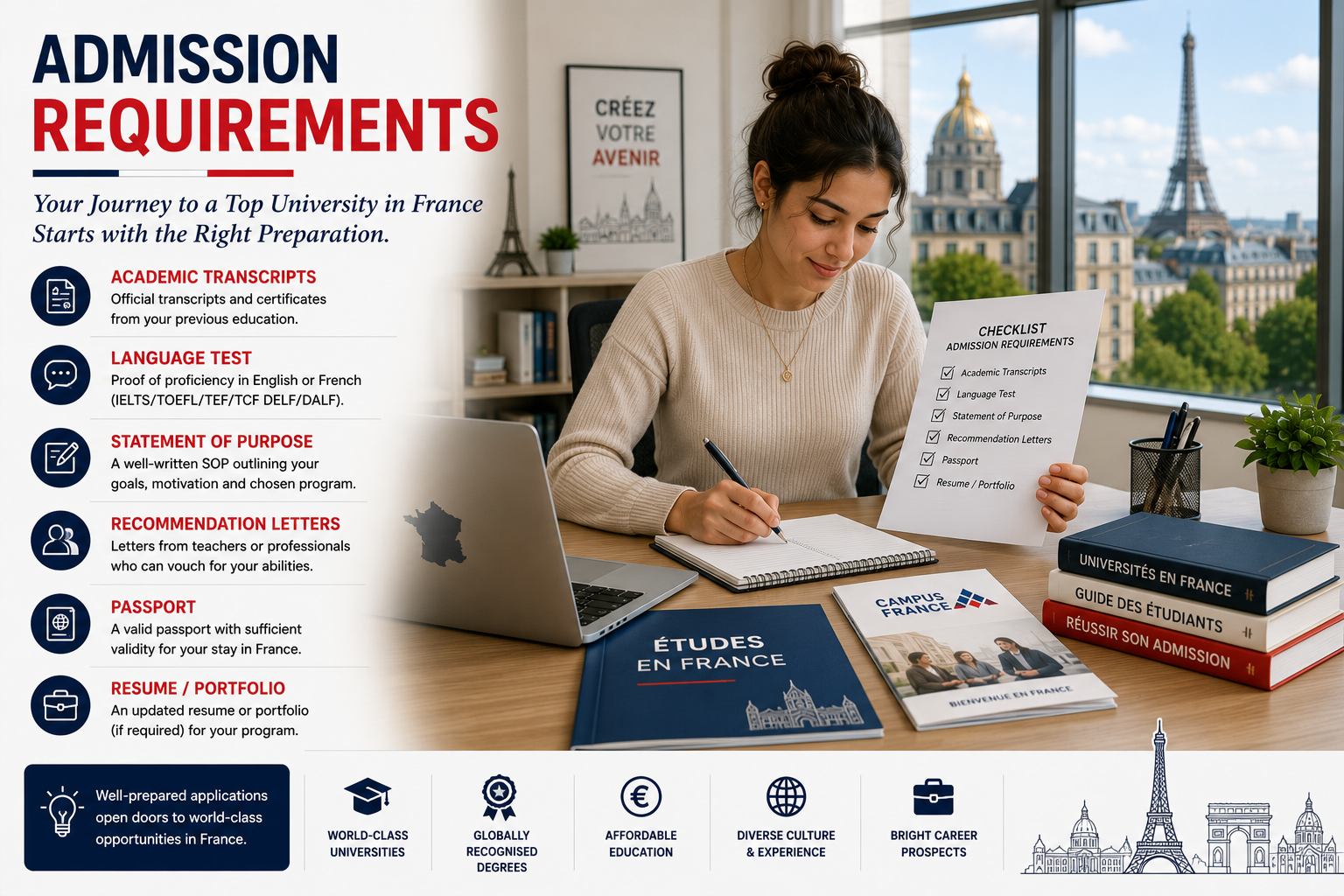
There is no single admission requirement applicable to every French university. Academic qualifications, subject prerequisites, language proficiency and supporting documents can differ considerably between institutions and programmes. Reviewing these requirements before applying helps students prepare a more complete application.
Indian students who have completed Class 12 can explore undergraduate programmes in France, subject to the institution's eligibility criteria.
Students applying for master's programmes generally need an appropriate bachelor's qualification. The relevance of the previous degree depends on the selected course.
English-taught programmes may accept IELTS, TOEFL or other recognised evidence of English proficiency, depending on the institution.
Some institutions may consider alternative evidence, including previous education in English. Acceptance of such evidence must be confirmed with the institution.
French-taught programmes may require proof of French proficiency through an accepted examination or qualification.
Depending on the programme, institutions may specify a required level under the Common European Framework of Reference for Languages (CEFR).
Some programmes require a statement of purpose or motivation letter explaining the student's academic interests, reasons for choosing the course and future plans.
Depending on the institution and discipline, recommendation letters, a CV, portfolio or work experience may also be required.
Universities may review the relationship between previous qualifications and the proposed programme, including subject relevance and academic progression.
Backlogs, study gaps or changes in academic direction should be explained accurately wherever the application requires clarification.
Before shortlisting institutions, review your academic history, subject background, study gaps and proposed course progression. Nexus Consultants' Profile Integrity & Visa Probability Audit can help identify documentation and profile-related issues that may need attention before an application is submitted.
Indian students planning to pursue higher education in France generally need to understand the Campus France and Études en France (EEF) procedure. This online process helps manage applicable admission formalities and connects the student's application journey with the subsequent student visa process.
Begin by creating your personal account on the official Études en France platform and entering the requested personal and academic information.
Enter your educational history, qualifications, language proficiency and other required details. Upload the documents requested by the platform.
Follow the application route applicable to your chosen programme and institution. Provide the required course choices and motivation for your applications.
Review your entries carefully and submit the file. Respond to any requests for clarification or correction communicated through the platform.
Depending on your application route, you may be invited for an academic interview. You should be prepared to explain your study plan, course selection and reasons for choosing France.
Follow university responses and complete the institution's acceptance and enrolment formalities. Make sure you understand the conditions attached to your offer.
Check your Études en France account for the latest application status, interview outcome where applicable and any additional instructions. Complete the required follow-up formalities before proceeding to the next stage.
After meeting the applicable EEF and admission requirements, prepare the visa application through France-Visas and follow the appointment and document submission instructions.
Applications to many public university programmes follow the Études en France procedure. The application calendar, programme choices and submission requirements depend on the course and academic level.
Some private institutions accept applications directly through their own admission portals. However, Indian applicants may still need to complete the applicable Campus France formalities for their long-stay student visa process.
Campus France India lists an EEF processing fee of ₹20,000, effective 1 August 2026. The applicable fee, payment instructions and any exemption should be confirmed on the official Campus France India website before payment. Visa and VFS charges are separate where applicable.
Understanding the cost of studying in France is essential before selecting a university or accepting an admission offer. Indian students should consider tuition fees, accommodation, everyday expenses, insurance and available scholarship opportunities when preparing their study-abroad budget.
For the 2026–2027 academic year, the published differentiated registration fees for eligible non-EU students at covered French public higher education institutions are:
| Study Level | Annual Tuition Fee | Programme |
|---|---|---|
| Bachelor's | €2,902 | National undergraduate degree |
| Master's | €3,950 | National master's degree |
| Doctoral / PhD | €398 | Doctoral registration |
Public institutions may offer comparatively affordable tuition under the applicable national fee framework. However, differentiated fees, exemptions and programme conditions must be checked individually.
Private institutions and specialised schools determine their own programme fees. Tuition can vary significantly according to the institution, qualification, subject and duration of study.
Accommodation and location are two of the biggest factors affecting a student's monthly budget. Campus France India provides the following indicative planning estimates:
An approximate monthly student budget. Rent and accommodation choices can have a significant effect on the total.
An approximate monthly student budget outside the Paris region, depending on the city and lifestyle.
Indian students can explore scholarship opportunities offered by the French government, universities, foundations, companies and international education programmes. Eligibility and funding coverage vary by scholarship.
The French Embassy in India offers scholarship opportunities for eligible Indian students pursuing higher education in France. Selection is competitive and depends on the specific scholarship programme.
The Eiffel programme supports outstanding international candidates applying for eligible master's and doctoral programmes through participating French institutions. Students generally need institutional nomination.
Eligible joint master's programmes may offer scholarships covering specified participation costs and providing financial support. Programme participation and selection conditions vary.
French universities and business schools may provide merit-based, excellence or tuition-waiver scholarships. Awards, eligibility and deadlines are institution-specific.
Joint scholarship initiatives supported by the French Embassy and partner organisations may offer financial assistance to eligible Indian applicants in selected fields and study levels.
Indian students can also investigate eligible overseas education scholarships and funding initiatives offered by Indian trusts and foundations, subject to their individual criteria.
Compare tuition fees, living expenses and scholarship opportunities across popular study destinations before choosing the country that best fits your academic goals and budget.
Indian students applying for a long-stay student visa for France must demonstrate that they have sufficient financial resources to support themselves during their studies. Understanding the current financial threshold and preparing consistent supporting documents are important parts of the visa application.
Effective 1 August 2026, the minimum financial resources requirement for French student visa applicants increased from €615 to €877.50 per month. Applicants should prepare evidence that meets the applicable requirement for their intended stay.
Earlier financial threshold applicable before 1 August 2026.
Updated minimum applicable to student visa applications from 1 August 2026.
The following figures illustrate the monthly minimum multiplied by different periods. They are calculations for planning purposes, not a universal instruction to maintain one specific lump-sum bank balance.
| Illustrative Period | Monthly Minimum | Total Calculation |
|---|---|---|
| 6 months | €877.50 | €5,265 |
| 9 months | €877.50 | €7,897.50 |
| 12 months | €877.50 | €10,530 |
These are mathematical illustrations only. The consular authorities assess the supporting evidence and the applicant's individual circumstances. The required documentation and period of financial coverage should be confirmed using the official visa checklist.
Financial resources may come from different sources. The evidence should be genuine, traceable and consistent with the applicant's financial circumstances.
Applicants may provide their own bank statements and supporting financial records to demonstrate that sufficient funds are available for their stay.
A parent or eligible sponsor may support the student's expenses. Supporting documents may include proof of relationship, sponsor identity, financial records and a sponsorship declaration where required.
Students receiving scholarships can provide official award documentation showing the funding amount, duration and expenses covered.
Other forms of financial support may be considered where accepted by the relevant authorities and supported by appropriate documentation.
A financial file should demonstrate genuine access to funds and a clear explanation of how the student's expenses will be supported.
After receiving admission to a French institution and completing the applicable Campus France formalities, Indian students must apply for the appropriate French student visa. For most degree programmes lasting longer than three months, this involves a long-stay student visa.
The application requires consistency between your admission details, academic background, study plan, financial documents and information submitted through the Études en France (EEF) procedure.
Students undertaking a course lasting more than three months generally require a long-stay visa. The visa category and formalities depend on the duration and nature of the programme.
A long-stay visa equivalent to a residence permit, generally issued for a stay of up to one year and subject to online validation after arrival.
Indian applicants should follow the applicable EEF procedure before proceeding with their visa application.
Obtain your official admission or enrolment confirmation from the French university or institution. Check that your programme, intake and personal details are accurate.
Complete the applicable Études en France procedure, respond to any document corrections and attend the academic interview if required. Follow the instructions issued through your EEF account.
Use the official France-Visas portal to complete the visa application. Select the appropriate student visa category and enter information consistent with your admission and EEF records.
Use the personalised document checklist generated through France-Visas. Organise your academic, financial, accommodation and admission documents before the appointment.
Follow the appointment instructions for applicants residing in India. Attend the designated visa application centre with the required documents and originals where requested.
Submit your application and supporting documents, provide biometric information where required and pay the applicable visa and service charges.
Your application is assessed by the competent French authorities. Processing time can vary depending on the application, season and individual circumstances. Track your application through the designated channel.
Once your passport is returned, carefully verify your name, visa category, validity dates and other details before making final travel arrangements.
The exact checklist depends on your programme, visa category and personal circumstances. Commonly requested documents may include:
Important: This is a general preparation list, not a substitute for the official France-Visas checklist. Do not assume that the same documents are required for every applicant. Follow the personalised checklist generated for your application.
If your visa is a VLS-TS (long-stay visa equivalent to a residence permit), you must complete its online validation within three months of arriving in France.
The process requires your visa details, arrival date, French residential address and payment of the applicable validation tax. This is a separate post-arrival requirement; receiving the visa alone does not complete it.
Students whose visa carries a different residence-permit instruction must follow the procedure stated on their visa.
Refer to these government and Campus France resources for the latest application instructions.
Visa requirements, supporting documents, fees and processing arrangements may change. The French authorities make the final decision on every visa application. Completion of the Campus France procedure or admission to a French institution does not guarantee visa approval.
International students in France can generally undertake part-time employment while studying, subject to their nationality and residence status. Working can provide practical experience, opportunities to improve French language skills and additional income towards everyday expenses.
However, employment should remain supplementary to a student's financial arrangements and academic commitments.
Students holding an eligible student VLS-TS or residence card can generally undertake salaried employment within the permitted annual limit.
Maximum annual working time in the general case, equivalent to 60% of the normal annual working time in France.
Students should understand these conditions before accepting employment.
Eligible non-EU students can generally work up to 964 hours annually. The applicable reference period depends on the issue of the residence card or validation of the VLS-TS.
Students must hold an eligible residence status. Employers generally have to make the required declaration to the prefecture before employment begins.
Employment should remain compatible with classes, examinations and academic progress. The maximum permitted hours may not be practical for every student.
Opportunities may include hospitality, restaurants, retail, customer service, university support roles and tutoring. Availability depends on location and language skills.
Understanding employment conditions before accepting a job can help students avoid legal, academic and financial difficulties.
Consult official sources for current employment conditions and regulations.
Employment rules vary according to nationality, residence status and the nature of the work. Apprenticeships, professional training contracts and course-related internships may have separate conditions. Verify your eligibility with the relevant French authorities before accepting employment.
France offers eligible international graduates a route to remain in the country after completing higher education and pursue employment or develop a business. This can be an important consideration for Indian students planning their long-term academic and career journey.
However, post-study residence options depend on the qualification obtained, the institution, the student's immigration status and the nature of the intended employment or business activity.
Eligible non-EU graduates may apply for the French temporary residence card or long-stay visa marked "Job Search / Business Creation" (recherche d'emploi / création d'entreprise).
The permit generally allows eligible graduates to stay in France for up to one year to seek employment or develop a qualifying business project. It is not renewable.
This route is not automatically available to every graduate. Eligibility is linked to the qualification and the conditions prescribed by French immigration rules.
The route generally covers graduates of a French institution who obtain a nationally recognised qualification at least equivalent to a master's degree, subject to the specific eligible qualifications and institution requirements.
Some qualifications, including specified professional licences and recognised specialised qualifications, may also qualify. Students should verify the exact diploma category rather than assume that every bachelor's or postgraduate course is covered.
The employment route is intended to help graduates obtain professional experience connected with their academic qualification or research.
Eligible graduates may use this route to develop a business project in a field corresponding to their education or research, subject to the applicable requirements.
The Job Search / Business Creation residence permit provides employment rights beyond the standard student work-hour limit, but the employment must satisfy specific conditions.
Under the current French government guidance, qualifying employment must be related to the graduate's studies and provide gross monthly remuneration above this threshold. The 964-hour student work limit does not apply during the validity of this particular permit.
The Job Search / Business Creation permit is temporary and non-renewable. Graduates who intend to remain in France must plan their next residence status before the permit expires.
Find a qualifying position connected with your studies and review the applicable salary and employment conditions.
Depending on the job and your circumstances, apply for the appropriate employee or other professional residence status.
If pursuing entrepreneurship, establish the project and meet the requirements for the appropriate self-employed or business-related residence status.
Complete the relevant application within the prescribed timeframe. Do not assume that submitting an application automatically extends every residence right.
Important for Indian students: The rules may differ according to nationality and applicable bilateral agreements. French government guidance identifies specific exceptions, including for Algerian nationals. Check the route that applies to your own nationality and qualification before relying on a general post-study work explanation.
Students should assess the career relevance of a programme before accepting admission. Consider the qualification awarded, recognition of the institution, employment opportunities in the field, French language requirements and the professional residence conditions that may apply after graduation.
Refer to these official sources for eligibility, residence procedures and current requirements.
Immigration eligibility, salary thresholds and residence procedures can change. The information above is a general guide, not an individual immigration assessment. Final eligibility and decisions rest with the competent French authorities.
Choosing to study in France is an important academic and financial decision. It requires more than selecting a university or submitting an application. Students need to understand programme suitability, admission criteria, language requirements, financial documentation, the Campus France process and the applicable student visa requirements.
Nexus Consultants is an Ahmedabad-based overseas education and immigration consultancy established in 2004. We work with students and families to make international education decisions through personalised counselling, structured application guidance and responsible documentation support.
Discover Who We Are — About Nexus Consultants →Founded in 2004, Nexus Consultants has developed its work around helping students understand their international education options and prepare applications with greater clarity. Our experience spans overseas education counselling, university admissions, documentation and student visa guidance.
We believe that every student deserves advice that considers individual academic history, financial circumstances, intended course and long-term objectives. Our role is to explain options, identify potential concerns and help students make informed decisions before moving forward.
Our approach is not based on a one-size-fits-all application process. It is based on suitability, preparation, transparency and attention to the details that matter.
Nexus Consultants is founded and led by Vishal Jani. The firm's advisory approach reflects a focus on responsible guidance, individual assessment and informed international education decisions.
Our agency accreditation, professional certification and industry memberships represent established connections with the wider international education community.
International education decisions carry academic, financial and personal consequences. These principles shape how we approach student counselling and application preparation.
We consider each student's academic background, study objectives, financial circumstances and proposed course before discussing suitable options.
We aim to explain application requirements, documentation, important considerations and potential limitations without unrealistic assurances.
We emphasise accurate information, consistent documentation and awareness of the relevant university, Campus France and visa procedures.
From initial course research to student visa documentation, our guidance is structured around the major stages of the France study application journey.
Review of academic qualifications, previous study, backlogs, study gaps and proposed course progression to understand potential admission considerations.
Guidance on suitable French universities and institutions, programme content, language of instruction, eligibility, tuition fees and location.
Assistance with application requirements, academic records, supporting documents, Statements of Purpose and institution-specific submission procedures.
Guidance on the applicable Campus France route, preparation of the Études en France file and understanding the relevant interview and procedural requirements.
Review of available financial evidence, sponsorship arrangements and supporting documentation for consistency with the student's study plans.
Guidance on the France-Visas application process, document organisation and consistency between academic, financial and visa application information.
For students who want a more detailed assessment before proceeding, our Profile Integrity & Visa Probability Audit provides a structured review of academic progression, financial verifiability and genuine student intent.
Whether you are exploring a public university, a private institution or an English-taught programme, the right starting point is an honest assessment of your academic profile, course objectives and financial readiness.
Nexus Consultants brings its experience in overseas education counselling and student visa guidance to students and families in Ahmedabad and across Gujarat who are planning their higher education journey in France.
Find answers to common questions about studying in France, including admission requirements, tuition fees, scholarships, financial documentation, student visas and post-study opportunities.
France offers internationally recognised higher education institutions, a wide selection of academic programmes, English-taught courses, scholarship opportunities and access to European career markets.
Students can choose from public universities, specialised institutions and private business or management schools. The right choice depends on academic background, budget, language preferences and career objectives.
For applications covered by the updated requirement effective 1 August 2026, the minimum financial resource benchmark is €877.50 per month.
For a 12-month period, this represents €10,530. The actual financial evidence required depends on the applicant's circumstances and accepted forms of support.
This is a visa financial-resource benchmark, not a complete estimate of actual living expenses. Students should check the latest official requirements before applying.
The cost depends on the institution, programme and city. For 2026–27, published differentiated public-institution tuition rates are €2,902 per year for bachelor's programmes and €3,950 per year for master's programmes.
Some students may qualify for exemptions or reduced fees. Private institutions and specialised programmes can have substantially different tuition fees.
Students should also budget for accommodation, food, transport, healthcare and personal expenses.
Yes, a study gap or previous academic backlog does not automatically make a student ineligible for admission in France. However, the institution will assess the applicant's academic history, previous qualifications and suitability for the selected programme.
Students should be prepared to explain significant study gaps, academic interruptions or backlogs honestly and provide supporting documentation wherever relevant.
Admission decisions remain with the university or institution.
Requirements vary according to the university, programme and level of study. Common requirements include:
Some programmes may also require entrance examinations, interviews, portfolios or specific subject prerequisites.
Yes. International students may explore French government scholarships, Eiffel Excellence scholarships, institutional scholarships, Erasmus Mundus programmes and other eligible funding opportunities.
Scholarship availability, eligibility, application deadlines and funding amounts vary by programme. Many scholarships are competitive and require a separate application.
Students should not assume that a scholarship is automatically granted with university admission.
Yes, some French institutions accept alternative proof of English proficiency or may waive IELTS if the applicant meets their specific language requirements.
Depending on the university, accepted alternatives may include other recognised English-language tests, previous education in English or an institutional assessment.
IELTS waiver policies differ between institutions, so students should confirm the exact requirements of their selected programme.
Eligible non-EU international students can generally work up to 964 hours per year in France, subject to their residence status and applicable conditions.
Students may explore opportunities in hospitality, retail, university support services and other sectors. Employment should remain compatible with academic commitments.
Part-time work should be considered supplementary income rather than the primary source of funding for studies.
Campus France is the French national agency responsible for promoting French higher education internationally. It also manages application procedures for international students in participating countries.
For Indian applicants, the Études en France (EEF) procedure is generally required where applicable. It involves submitting academic and application information and completing the relevant Campus France formalities.
The exact procedure depends on the institution and programme. Completing the Campus France process does not itself guarantee university admission or a visa.
Eligible international graduates may apply for the Job Search / Business Creation residence route, generally for up to 12 months.
Eligibility depends on the qualification obtained, the institution and other immigration conditions. It is not automatically available to every graduate.
Graduates who secure qualifying employment or establish an eligible business may be able to apply for a different residence status, subject to the applicable rules.
Yes. French universities and higher education institutions offer a range of English-taught programmes, particularly at postgraduate level. Options are also available in selected undergraduate and specialised programmes.
Students should check the language of instruction, English proficiency requirements, curriculum and availability of the chosen course directly with the institution.
Learning French can also help students with everyday communication, internships and employment opportunities.
Nexus Consultants has been guiding students from Ahmedabad since 2004. Our support includes academic profile evaluation, university and programme selection, admission documentation, Campus France guidance, financial documentation and student visa application preparation.
We focus on helping students prepare consistent applications based on their individual academic and financial circumstances.
Students seeking a structured pre-application review can also explore our Profile Integrity & Visa Probability Audit.
Information is provided as general guidance. University admission requirements, tuition fees, scholarship availability and immigration rules may change. Students should verify current requirements with the relevant institution and official authorities before applying.
Whether you are exploring French universities, comparing courses or preparing for a student visa application, Nexus Consultants can help you understand your options and plan your next steps.
Admission, scholarship and visa decisions are made by the relevant institutions and authorities. Nexus Consultants provides professional guidance and application support but does not guarantee any specific outcome.